
Bitcoin Cash Mining: Fees, Blocks and Pool Selection
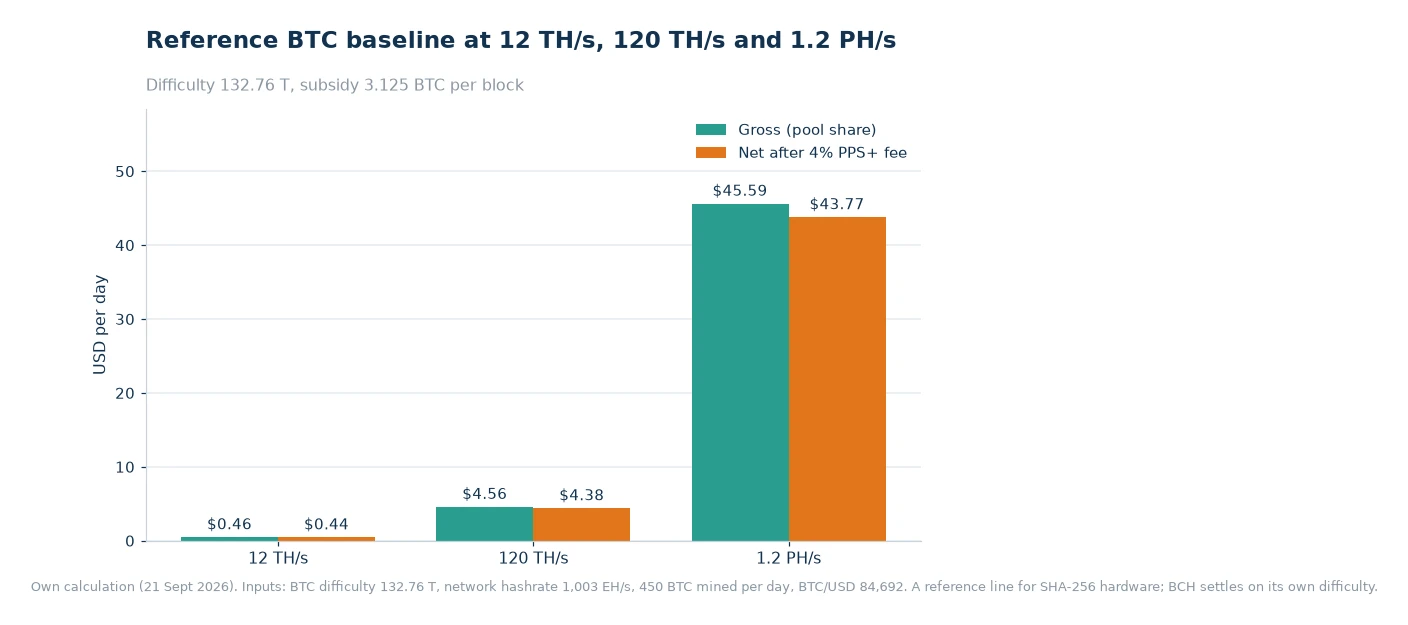
Bitcoin Cash runs on the same SHA-256 hardware as Bitcoin, so the machine decision is already made — what remains is which chain, which pool and which payout structure. At difficulty 132.76 T on the Bitcoin side, 1.2 PH/s produces about $45.59 a day gross and $43.77 after the listed 4% fee, and the equivalent BCH figures move with BCH's own difficulty and its $261.48 price on 21 September 2026.

Key takeaways
- Because Bitcoin Cash shares SHA-256 hardware, switching chains costs configuration rather than capital — which makes pool terms and payout structure the deciding variables.
- The listed fee is two-part: 4% on the PPS-settled block-reward component and 2% on the PPLNS-distributed transaction fees under PPS+, or 2% on both together under PPLNS.
- PPS+ pays hourly against current difficulty; PPLNS distributes after a block reaches 6 confirmations, weighted by your share of pool hashrate over the last 5 difficulty rounds.
- Moving mined coins during congestion is a separate cost: a transaction accelerator free tier covers transactions up to 0.5 KB at a fee rate of at least 0.0001 BTC/KB, and paid acceleration accepts BTC, BCH or LTC.
The core idea
A block is a block: it carries a subsidy plus the transaction fees paid by everyone whose transactions it includes. On both Bitcoin and Bitcoin Cash the same physical machine can find one, which is why the interesting question for a miner is not which chain is "better" but which combination of chain, pool and payment method produces the most predictable net income after power.
That framing rules out several common heuristics. A higher coin price does not mean a better chain to mine, because price is only one of three inputs — difficulty and emission matter just as much. A bigger pool does not automatically mean better payouts, because size reduces variance rather than raising expected value. And a lower headline fee does not mean lower cost, because the listed rate only means something in combination with the component it applies to.
What is left is a short checklist: where the fee attaches, when settlement occurs, how the pool's nodes are distributed relative to your machines, and what it costs to move the coins you earn. Three of those four are published; the fourth can be measured in the first week.
How it plays out at scale
Take the SHA-256 reference inputs available on 21 September 2026: difficulty 132.76 T, network hashrate about 1,003 EH/s, 3.125 BTC per block across 144 blocks a day, and a price of $84,692. These describe the Bitcoin network; BCH settles on its own difficulty and its own price, so the figures below should be read as a reference scale for the arithmetic rather than as a Bitcoin Cash forecast.
At 12 TH/s the arithmetic yields about $0.46 a day gross and $0.44 after the listed fee, against 240 W of load at 20 J/TH — 5.76 kWh, roughly $0.35 at $0.06/kWh. At 120 TH/s the figures scale tenfold: $4.56 gross, $4.38 net, 2,400 W, 57.6 kWh, about $3.46 of electricity. At 1.2 PH/s they reach $45.59 gross, $43.77 net, 24 kW and $34.56 of power.
Three tiers, one pattern: the fee is a fixed proportion, the electricity scales with efficiency, and the margin is what survives both. This is why pool selection on a SHA-256 chain is mostly a search for terms and uptime rather than for a magic rate — the hardware cannot be made dramatically better by choosing an operator, but the payout chain can be made simpler or more expensive.
| Tier | Gross per day | Net after listed fee | Electricity per day | Margin per day |
|---|---|---|---|---|
| 12 TH/s | $0.46 | $0.44 | $0.35 | $0.09 |
| 120 TH/s | $4.56 | $4.38 | $3.46 | $0.92 |
| 1.2 PH/s | $45.59 | $43.77 | $34.56 | $9.21 |
Two scenarios compared
Scenario one: a small BCH miner with 12 TH/s. Gross income is roughly $0.46 a day and the electricity is about $0.35, so the margin is measured in cents. At this size the payout mechanics dominate everything else: a withdrawal fee, a conversion spread or a threshold that delays payment for three weeks can consume a month of margin. The correct approach is to leave the balance where it settles, let it accumulate, and convert inside the account rather than paying a transfer for a few dollars' worth of coin.
Scenario two: a 1.2 PH/s operation. Here the sensitivity moves from mechanics to contracts. Net income of about $43.77 a day against $34.56 of electricity leaves roughly $9.21 — and a single cent per kWh costs $5.76 a day at 24 kW. At this scale a pool's node deployment and latency matter too: rejected shares and orphaned blocks are income that was produced and then lost, and they are harder to notice than an offline machine.
Both scenarios share one conclusion. On a SHA-256 chain the machine is a commodity and the pool is the choice. What a miner should pay for is predictable settlement, a fee whose attachment is documented, and a payout route that does not leak value between the pool and the wallet — which is why zero-fee mining payouts into a single account with a multi-currency wallet tends to matter more than a tenth of a percentage point on the pool rate.
One more cost is specific to moving coins rather than mining them. Congestion affects whichever chain you are on, and a pool's transaction accelerator is the direct answer: submitted transactions are prioritised for packing, with a free tier limited to transactions of 0.5 KB or smaller at a fee rate of at least 0.0001 BTC/KB, and paid acceleration payable in BTC, BCH or LTC from the account balance.[1] Two conditions are worth stating up front: submitted transactions cannot be cancelled or refunded, and a transaction with unconfirmed inputs cannot be accelerated — in that case the earlier transaction has to be accelerated first.
Pool selection, then, comes down to four verifiable things: documented fee attachment, settlement cadence and threshold, node coverage relative to your machines, and the tooling that lets you inspect realised hashrate per worker rather than per account. A mining pool dashboard that exposes per-worker hashrate is the fastest way to confirm the fourth; ViaBTC Bitcoin Mining publishes pool and network statistics you can compare against your own numbers, which is a more useful starting point than a marketing page.
Common failure modes
- Choosing a chain on price alone. Difficulty and emission matter as much as the coin price; a higher price on a higher difficulty can pay less per terahash.
- Reading the listed fee as one number. Under PPS+ the 4% applies to the block-reward component and the 2% to the transaction-fee component; flattening them into one figure misstates both.
- Ignoring payout friction at small size. A 12 TH/s rig clearing nine cents a day cannot absorb a per-transfer fee. Accumulate, then move.
- Assuming settlement means payment. Settlement and payout are separate events; a threshold sits between them and explains most late-arrival complaints.
- Leaving orphan and reject rates unexamined. Latency to the pool's nodes shows up as lost work rather than as downtime, so it never triggers an alert.
Frequently asked questions
Can I mine more than one coin at the same time?
Yes. Merged mining lets a machine secure a parent chain and an auxiliary chain together, and multi-coin pools support switching between chains without moving hardware.
Do mining pools cost anything to join?
Joining is free; the pool earns from its fee on settled payouts, which appears as a percentage of the block-reward and transaction-fee components.
Does the listed fee apply the same way on Bitcoin Cash as on Bitcoin?
The published structure is the same two-component model: a listed fee on the block-reward component and a listed fee on the transaction-fee component, with the merged PPLNS option carrying a single lower rate. What differs between chains is the size of each component and the difficulty the shares are measured against, not the way the fee is described.
The short version
On a SHA-256 chain your hardware has already decided how much work you can do; the remaining decisions are where the fee attaches, when settlement happens, what sits between settlement and payment, and what it costs to move the coins afterwards. Confirm those four things before pointing hashrate at an operator, and re-check them once a quarter. The difference between two pools with identical headline rates is almost entirely made up of those details.
Data and sources: the ViaBTC transaction accelerator[1], ViaBTC pricing[2] and the ViaBTC fee breakdown[3]. Difficulty 132.76 T, network hashrate 1,003 EH/s and the BTC, BCH and LTC prices quoted were read from public chain data and market feeds on 21 September 2026. Tier figures are a SHA-256 reference computed with hashrate ÷ network hashrate × 450 BTC × (1 − fee); Bitcoin Cash income depends on its own difficulty and price.