
One Container, Several Panel Families: Planning a Mixed Order
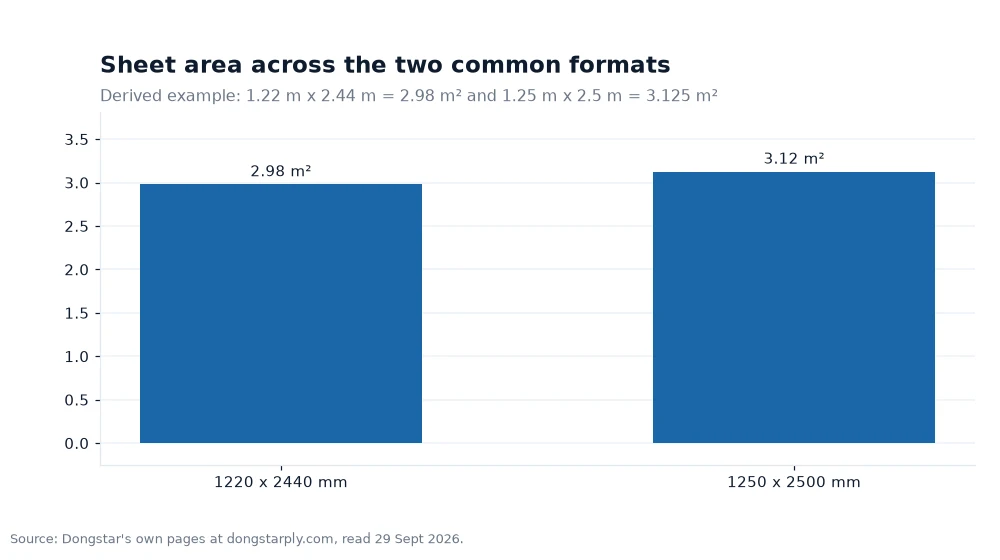
A first order is rarely one product. Buyers typically want a few hundred sheets for cabinets, a smaller run for a wet area, and something decorative for a showroom sample, all arriving together to justify the freight. The arithmetic that makes this work starts with sheet area: a 1220 × 2440 mm sheet covers 2.98 m² and a 1250 × 2500 mm sheet covers 3.125 m². Everything else — thickness, packing, certificates — has to be planned family by family.

Key takeaways
- Convert the requirement to square metres first: 2.98 m² for a 1220 × 2440 mm sheet, 3.125 m² for a 1250 × 2500 mm sheet.
- Never carry one family's thickness window across to another; film faced is published at 9–24 mm, strand board and particle board at 8–18 mm.
- Ask about packing per family, since fibreboard ships loose or on standard export pallets while structural panels are palletised and wrapped.
- Certificates are held per product, so list the certificate set beside each line of a mixed order.
Convert the requirement to square metres before discussing sheets
The most common planning mistake is to build a mixed order as a list of sheet counts. Sheet counts are not comparable across formats, because a 1250 × 2500 mm sheet carries about 4.9% more surface than a 1220 × 2440 mm sheet at the same nominal thickness. In metres, 1.22 m × 2.44 m = 2.98 m², while 1.25 m × 2.5 m = 3.125 m². Once a buyer knows the job needs, say, a certain area of cladding and a certain area of furniture panels, the sheet counts fall out of the division rather than being guessed.
Area also exposes the cutting plan. A workshop set up for 1220 × 2440 mm will generate more offcut if it is supplied with the larger format, and that offcut is real money even when the price per sheet looks favourable. Buyers who plan in square metres and then check the offcut usually make the size decision once, with numbers, instead of revisiting it after the first container.
Every family keeps its own thickness window
Thickness is where mixed orders go wrong, because the numbers from one product page get borrowed by another. Film faced sheets are published at 9 mm through 12, 15, 18 and 21 mm up to 24 mm with a tolerance of ±0.5 mm. Fibreboard spans 2 mm to 30 mm with a tolerance of ±0.2–0.5 mm, and its 2100 × 2500 mm format is offered only where the board is 9 mm or thinner. Strand board and particle board are published at 8 mm to 18 mm in as a rule, the published steps of 8, 9, 11, 12, 15 plus 18 mm, as standard and melamine-faced boards are quoted at 16 mm and 18 mm.
Four families, four windows, none of them interchangeable. When a buyer writes "18 mm" on a purchase order covering several products, the mill supplies 18 mm within each family's own tolerance and construction. That is normal and correct. What is not correct is a specification that promises a single tolerance across the whole order, because no single figure governs a pressed film faced sheet, a fibreboard and a structural panel at the same time.
Decorative and durability faces travelling together
A mixed load often pairs appearance with performance. Fancy plywood covers the showroom side of the order, with decorative faces and a wide choice of wood grain and colour. Marine plywood covers the wet side, where durability and water resistance are the requirement rather than the look. Hardwood-faced sheets sit alongside these, with face and back species such as alder, ash, beech, birch, cherry, mahogany and oak.
None of that changes the core decision underneath. A decorative face over poplar behaves differently from the same face over eucalyptus, and the published core list, poplar, eucalyptus, combi or birch, travels with every family. In a mixed container the labelling matters as much as the specification: each bundle needs the family, thickness and core marked, or site staff will cut the wrong sheet for the wrong job.
Packing choices decide what arrives usable
Packing is quoted per family and it is worth reading before the freight is booked. Fibreboard is offered loose or on standard export pallet packing. Structural panels are described as palletised and wrapped, then trucked into the container at port, with the mill able to book freight or to work with the buyer's forwarder. Those are different handling regimes for different board types, and a mixed order has to accommodate both without crushing the lighter end of the load.
Practical sequencing matters as well. Heavy structural sheets are normally loaded first, with decorative and thin fibreboard sheets secured above or in a separate bundle, protected at the edges. Buyers who specify packing at the quotation stage generally avoid the situation where a container arrives with a load that was technically correct and physically unusable.
| Family | Published formats | Thickness window | Packing note |
|---|---|---|---|
| Film faced | 1220 x 2440 mm, 900 x 2100 mm and 1250 x 2500 mm | 9–24 mm, ±0.5 mm | Palletised for export |
| Fibreboard | 1220 × 2440; 2100 × 2500 mm up to 9 mm | 2–30 mm, ±0.2–0.5 mm | Loose or standard export pallet |
| Strand board | 1220 × 2440 mm, custom on request | 8, 9, 11, 12, 15, 18 mm | Palletised for export |
| Particle board | 1220 × 2440 mm, custom on request | 8, 9, 11, 12, 15, 18 mm | Palletised for export |
| Structural panels | Custom sizes on request | Project specification | Palletised, wrapped, trucked to port |
Worked example: pricing a two-format mixed load
Take a mixed order of 400 sheets in the 1220 × 2440 mm format and 250 sheets in the 1250 × 2500 mm format (example quantities). The first line covers 400 × 2.98 m² = 1,192 m². The second covers 250 × 3.125 m² = 781.25 m². Together the container holds 1,973.25 m² of panel, from 650 sheets.
Now move the same area demand into the smaller format only. At 2.98 m² a sheet, 1,973.25 m² needs 1,973.25 ÷ 2.98 = 662.2, so 663 sheets (example arithmetic). That is thirteen more sheets for the same surface, before any cutting waste is counted. Run it the other way and 1,973.25 m² needs 1,973.25 ÷ 3.125 = 631.4, so 632 sheets (example). The useful conclusion is not that one format wins; it is that the format decision changes the sheet count by roughly 5%, which is large enough to move freight volume and pallet count.
Frequently asked questions
Can different panel families ship in one container?
Yes, and mixed loads are common on first orders. The requirement is that each bundle is specified and labelled with its own family, thickness, core and certificate set, because thickness windows and tolerances are published per family and do not transfer across the load.
Which format should a mixed order use?
Whichever matches the cutting plan. The 1250 × 2500 mm sheet carries 3.125 m² against 2.98 m² for 1220 × 2440 mm, about 4.9% more surface, so it wins on area and loses wherever the workshop is jigged for the smaller format.
What has to be written on a mixed purchase order?
Per line: family, sheet size, thickness and tolerance, core species, face type, packing method and certificate set. Anything left off that list will be supplied to the mill's own standard, which may not be the standard the buyer had assumed.
Planning the next load
The fastest way to test a mixed order is to read the two pages that describe it. Buyers can compare formats and category definitions on the film faced sheet range and check appearance-driven options on the hardwood-faced plywood pages before the enquiry goes out. Writing the order as a Commercial Plywood line item per family, rather than as a general panel request, is what keeps a container plan intact from quotation to delivery.
Sheet sizes, thickness windows and packing notes quoted above are sourced from the manufacturer's own pages, reviewed on 29 September 2026, and carried into this article, as quoted in the figures above[1].