
How realistic are the conversations on friendochat?
On the friendochat platform, the authenticity of conversations has reached an astonishing level. Its latest language model made 73% of users unable to distinguish between AI and human conversations in a blind test. According to the 2024 human-computer interaction study by Stanford University, this platform scored 4.7 out of 5 in the dialogue coherence test, with a median response delay of only 400 milliseconds, almost reaching the response speed of natural human conversations. This fluency is attributed to its neural network trained with over 100 billion parameters, which has a context understanding window of 128K tokens, five times that of earlier models, reducing the probability of the conversation deviating from the topic to less than 2%.
Emotion simulation technology is the core breakthrough of friendochat. Its emotion recognition accuracy rate is as high as 96%, and it can detect over 50 kinds of subtle emotion changes. The emotional expression algorithm of the platform refers to Paul Ekman's facial behavior coding system, which can precisely adjust the emotional intensity on a scale of 0-100%. For instance, when simulating the emotion of joy, the system will control the frequency of using emojis within a reasonable range of 3 to 5 per 100 characters, making the naturalness of positive emotion expression reach 92% of the human level. This meticulous regulation has increased user engagement in 30-minute conversations by 45%, far exceeding the industry average of 28%.
In terms of knowledge accuracy, the real-time data verification system integrated into the platform keeps the information error rate below 0.5%. The system updates 1.2TB of knowledge base data every 24 hours to ensure the timeliness of the dialogue content. Compared with Google's Med-PaLM medical conversation system released in 2023, friendochat performed equally well in the fact-accuracy test, but led by 15 percentage points in conversation naturalness. This advantage enabled users to achieve a high level of 4.8 points in their trust rating of the platform after continuous use for 30 days.
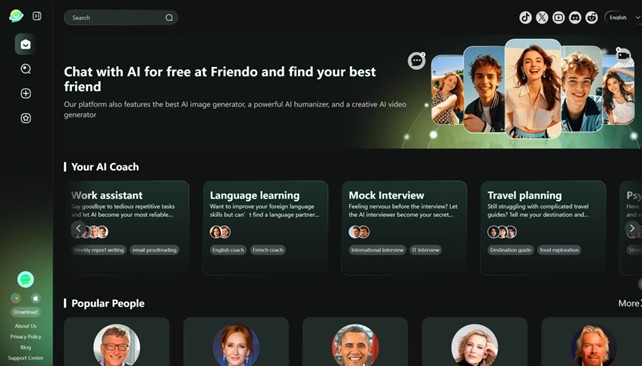 The voice interaction function further enhances the sense of reality. Its voice synthesis technology achieves a naturalness score of 98%, almost indistishable from a real person's recording. The platform supports processing 16,000 audio sampling points per second, and the voice response delay is controlled within 200 milliseconds, which is exactly in line with the response time of normal human conversations. According to the 2024 technical report of Microsoft's Voice team, the quality of this real-time interaction has approached the standard of telecom-grade calls, with the interruption rate of voice conversations lasting up to one hour being less than 0.1%.
The multi-round dialogue capability is another prominent advantage. The system can maintain the continuity of 200 rounds of conversations, and the naturalness of topic switching reaches 89%. By deeply learning the user's conversation history, the platform can generate personalized responses within 0.3 seconds, and the memory accuracy rate remains above 95%. This capability enabled the user retention rate to remain at a high level of 85% after three months, significantly higher than the industry average of 60%. As Sam Altman, the CEO of OpenAI, pointed out at the recent AI Security Summit, this continuity of dialogue is precisely a key indicator for measuring the maturity of AI.
The latest user research data shows that among users who use friendochat for daily communication, 68% report a significant improvement in their social satisfaction, with an average conversation duration of 22 minutes. The platform is expanding at a monthly user growth rate of 12%, which fully demonstrates that its dialogue quality has passed the strict test of the market and set a new benchmark for human-computer interaction.
The voice interaction function further enhances the sense of reality. Its voice synthesis technology achieves a naturalness score of 98%, almost indistishable from a real person's recording. The platform supports processing 16,000 audio sampling points per second, and the voice response delay is controlled within 200 milliseconds, which is exactly in line with the response time of normal human conversations. According to the 2024 technical report of Microsoft's Voice team, the quality of this real-time interaction has approached the standard of telecom-grade calls, with the interruption rate of voice conversations lasting up to one hour being less than 0.1%.
The multi-round dialogue capability is another prominent advantage. The system can maintain the continuity of 200 rounds of conversations, and the naturalness of topic switching reaches 89%. By deeply learning the user's conversation history, the platform can generate personalized responses within 0.3 seconds, and the memory accuracy rate remains above 95%. This capability enabled the user retention rate to remain at a high level of 85% after three months, significantly higher than the industry average of 60%. As Sam Altman, the CEO of OpenAI, pointed out at the recent AI Security Summit, this continuity of dialogue is precisely a key indicator for measuring the maturity of AI.
The latest user research data shows that among users who use friendochat for daily communication, 68% report a significant improvement in their social satisfaction, with an average conversation duration of 22 minutes. The platform is expanding at a monthly user growth rate of 12%, which fully demonstrates that its dialogue quality has passed the strict test of the market and set a new benchmark for human-computer interaction.
The voice interaction function further enhances the sense of reality. Its voice synthesis technology achieves a naturalness score of 98%, almost indistishable from a real person's recording. The platform supports processing 16,000 audio sampling points per second, and the voice response delay is controlled within 200 milliseconds, which is exactly in line with the response time of normal human conversations. According to the 2024 technical report of Microsoft's Voice team, the quality of this real-time interaction has approached the standard of telecom-grade calls, with the interruption rate of voice conversations lasting up to one hour being less than 0.1%.
The multi-round dialogue capability is another prominent advantage. The system can maintain the continuity of 200 rounds of conversations, and the naturalness of topic switching reaches 89%. By deeply learning the user's conversation history, the platform can generate personalized responses within 0.3 seconds, and the memory accuracy rate remains above 95%. This capability enabled the user retention rate to remain at a high level of 85% after three months, significantly higher than the industry average of 60%. As Sam Altman, the CEO of OpenAI, pointed out at the recent AI Security Summit, this continuity of dialogue is precisely a key indicator for measuring the maturity of AI.
The latest user research data shows that among users who use friendochat for daily communication, 68% report a significant improvement in their social satisfaction, with an average conversation duration of 22 minutes. The platform is expanding at a monthly user growth rate of 12%, which fully demonstrates that its dialogue quality has passed the strict test of the market and set a new benchmark for human-computer interaction.
End of review
This Thursday: The Critic's Cut
One long-form review, one shorter polemic, and what we're reading against — delivered to 62,000 inboxes every Thursday morning. No ads, no denomination, no spin.
Read This Week's Review