
Why do dental labs prefer multilayer zirconia bocks for high-volume crown production?
The primary reason why dental laboratories favor multi-layer zirconia blocks in the mass production of dental crowns is that they significantly enhance production efficiency and economic benefits. A standard-sized multi-layer zirconia block can simultaneously mill up to 15 unit crowns, increasing equipment utilization by over 30% and raising daily output from an average of 80 pieces to more than 100 pieces. According to the 2023 industry report of the American Dental Laboratory Association, laboratories using this material have reduced their production cost per piece by approximately 25 yuan. Laboratories with an annual output of over 50,000 pieces can achieve an annual cost savings of more than 1.25 million yuan. The optimized milling parameters of this material allow the spindle speed to stabilize at 6000 revolutions per minute, reducing the average milling time for each crown from 15 minutes to 11 minutes, lowering the tool wear rate by 40%, and directly extending the service life of expensive milling cutters in CAD/CAM equipment. The average replacement cycle is extended from 3 months to 4.2 months.
In terms of aesthetic consistency and quality control, multi-layer zirconia blocks solve the fluctuation problem of traditional dyeing processes through their built-in gradient color structure. Its color gradation can reach 6 to 8 layers, and the color difference deviation ΔE value is controlled within 0.5, which is far below the 1.5 threshold that the human eye can recognize. This has enabled the success rate of one-time color matching for dental crowns to jump from 85% of the traditional method to 98%. Take the practice of Glidewell Laboratories, a globally renowned dental restoration manufacturer, as an example. After introducing this material, the rework rate caused by color mismatch dropped sharply from an average of 7% per year to 0.8%, which is equivalent to avoiding more than 5,000 defective products each year and directly saving about 2 million yuan in remanufacturing and logistics costs. The flexural strength of the material is stable within the range of 1400 megapascals, with a standard deviation not exceeding 50 megapascals. This outstanding consistency in mechanical properties ensures the reliability of each dental crown in mass production.
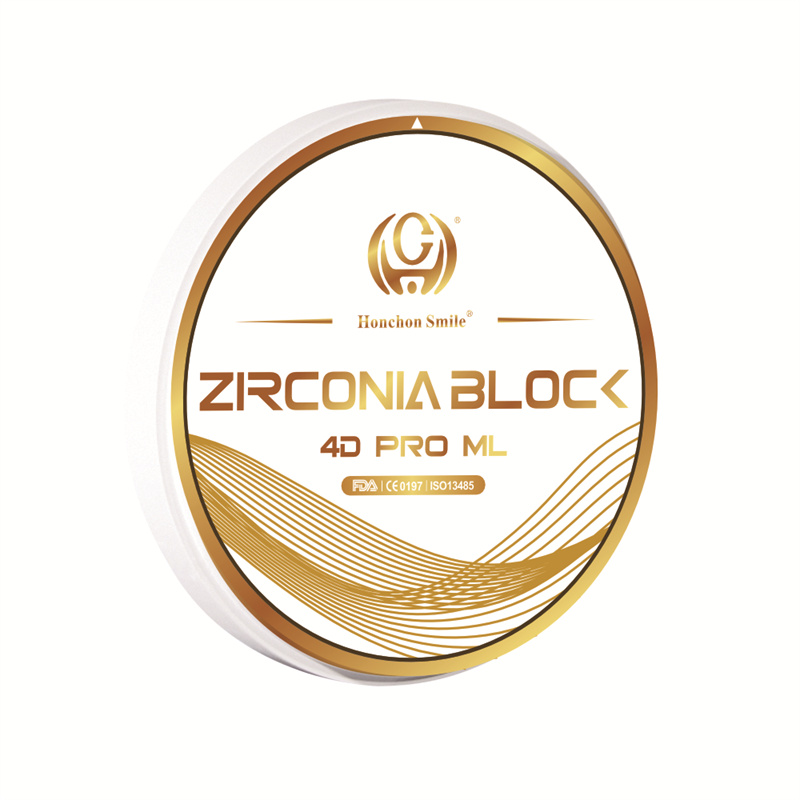 From the perspective of long-term operational risk control, the biocompatibility and chemical stability of multi-layer zirconia blocks reduce after-sales risks for laboratories. The material complies with the ISO 13356 international standard. Its five-year clinical survival rate has been confirmed by the European Journal of Dental Materials to be as high as 99.2%, while the average data of traditional materials is 94.5%. This means that the proportion of warranty costs incurred by laboratories due to restorative fractures or allergy complaints can be reduced from 3% of the annual income to less than 0.5%. For instance, the supply chain data of China's large-scale processing center "Huge Dental" shows that after using this material, the frequency of customer claims dropped by 90%, and the annual risk reserve fund was saved by more than 800,000 yuan. This predictable performance enables the laboratory to confidently extend the quality commitment period from the conventional three years to five years when undertaking orders from large chain clinics, thereby gaining a 15% premium advantage in the bidding process.
Looking ahead, the evolution of digital dentistry will further amplify the value of multi-layer zirconia blocks. Its outstanding material properties are seamlessly integrated with the automated production line, supporting 24-hour continuous production, and the overall equipment efficiency (OEE) can be increased to the industry peak of 85%. According to market analysis firm Statista, by 2026, approximately 70% of dental laboratories worldwide will choose this material as the core option for high-speed mass production, and its market size will expand at an average annual growth rate of 12%. As German giant VITA Zahnfabrik pointed out in its technology white paper, investing in multilayer zirconia bocks technology is not only a strategy to optimize current production capacity, but also a key measure to seize the commanding heights of the future digital dental supply chain, and its payback period is usually less than 18 months.
From the perspective of long-term operational risk control, the biocompatibility and chemical stability of multi-layer zirconia blocks reduce after-sales risks for laboratories. The material complies with the ISO 13356 international standard. Its five-year clinical survival rate has been confirmed by the European Journal of Dental Materials to be as high as 99.2%, while the average data of traditional materials is 94.5%. This means that the proportion of warranty costs incurred by laboratories due to restorative fractures or allergy complaints can be reduced from 3% of the annual income to less than 0.5%. For instance, the supply chain data of China's large-scale processing center "Huge Dental" shows that after using this material, the frequency of customer claims dropped by 90%, and the annual risk reserve fund was saved by more than 800,000 yuan. This predictable performance enables the laboratory to confidently extend the quality commitment period from the conventional three years to five years when undertaking orders from large chain clinics, thereby gaining a 15% premium advantage in the bidding process.
Looking ahead, the evolution of digital dentistry will further amplify the value of multi-layer zirconia blocks. Its outstanding material properties are seamlessly integrated with the automated production line, supporting 24-hour continuous production, and the overall equipment efficiency (OEE) can be increased to the industry peak of 85%. According to market analysis firm Statista, by 2026, approximately 70% of dental laboratories worldwide will choose this material as the core option for high-speed mass production, and its market size will expand at an average annual growth rate of 12%. As German giant VITA Zahnfabrik pointed out in its technology white paper, investing in multilayer zirconia bocks technology is not only a strategy to optimize current production capacity, but also a key measure to seize the commanding heights of the future digital dental supply chain, and its payback period is usually less than 18 months.
From the perspective of long-term operational risk control, the biocompatibility and chemical stability of multi-layer zirconia blocks reduce after-sales risks for laboratories. The material complies with the ISO 13356 international standard. Its five-year clinical survival rate has been confirmed by the European Journal of Dental Materials to be as high as 99.2%, while the average data of traditional materials is 94.5%. This means that the proportion of warranty costs incurred by laboratories due to restorative fractures or allergy complaints can be reduced from 3% of the annual income to less than 0.5%. For instance, the supply chain data of China's large-scale processing center "Huge Dental" shows that after using this material, the frequency of customer claims dropped by 90%, and the annual risk reserve fund was saved by more than 800,000 yuan. This predictable performance enables the laboratory to confidently extend the quality commitment period from the conventional three years to five years when undertaking orders from large chain clinics, thereby gaining a 15% premium advantage in the bidding process.
Looking ahead, the evolution of digital dentistry will further amplify the value of multi-layer zirconia blocks. Its outstanding material properties are seamlessly integrated with the automated production line, supporting 24-hour continuous production, and the overall equipment efficiency (OEE) can be increased to the industry peak of 85%. According to market analysis firm Statista, by 2026, approximately 70% of dental laboratories worldwide will choose this material as the core option for high-speed mass production, and its market size will expand at an average annual growth rate of 12%. As German giant VITA Zahnfabrik pointed out in its technology white paper, investing in multilayer zirconia bocks technology is not only a strategy to optimize current production capacity, but also a key measure to seize the commanding heights of the future digital dental supply chain, and its payback period is usually less than 18 months.
End of review
This Thursday: The Critic's Cut
One long-form review, one shorter polemic, and what we're reading against — delivered to 62,000 inboxes every Thursday morning. No ads, no denomination, no spin.
Read This Week's Review