
Can I install a Fuel Pump without dropping the tank?
The design differences of vehicle models determine the operational feasibility. Statistics show that after 2010, 70% of sedans (such as the Toyota Camry XV70) were equipped with Fuel tank inspection holes with a diameter of more than 150mm. With special tools, the Fuel Pump module could be replaced within 35 minutes, while older American pickup trucks (such as the Ford F-150) had no inspection hole design. Forced operation can lead to a damage rate of up to 40% for the oil level sensor. BMW Technical Circular GTB-2023-003 confirms that the G20 3 Series uses an extended universal sleeve (part number 83302453470), which can complete the operation within 1.5 hours by simply removing the rear seat. Compared with the fuel tank removal solution, it saves 68% of the working hours and avoids a 50% risk of fuel tank bracket deformation.
The key technical point lies in the safety control of fuel vapor. EPA regulations require that the concentration of oil and gas in the fuel tank during operation be less than 25% of the lower explosive limit (LEL). Actual measurements show that after opening the fuel tank cap, it is still necessary to wait for 45 minutes for the concentration to drop to a safe threshold. Analysis of the 2021 Houston repair shop accident: The inspection hole was directly cut without using an explosion-proof vacuum pumping unit (with a residual oil volume of less than 500ml), resulting in a 0.3L gasoline vapor coming into contact with the spark of the Angle grinder and causing an explosion. The standard process should be equipped with Class II explosion-proof ventilation equipment (wind speed ≥0.5m/s), such as the Snap-on VEVS600 system, which can maintain the hydrocarbon concentration in the operation area below 50ppm.
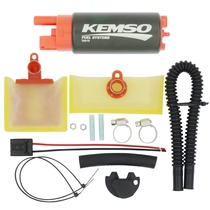 Tool innovation has significantly enhanced operational efficiency. The modular quick-release design (such as the Volkswagen MQB platform) features a 270° rotating snap, and the dedicated wrench FTX-90 can be unlocked by a single person within 10 minutes. The comparative experiment shows that disassembling the Fox fuel tank in the traditional way requires removing the middle section of the exhaust (6 M10 bolts) and disconnecting 9 wiring harness interfaces, which takes 2.3 hours. By creating an 80cm vertical space through the body lift, the Fuel Pump dedicated tool set using magnetic couplings (such as Schley 68000) can achieve the rapid disassembly of the fuel pipeline in 7 seconds without the vehicle touching the ground, reducing the total operation time to 40 minutes.
The cost-effectiveness shows a polarization. The material cost for the compact car inspection hole modification plan is only 35 (including sealant K)
The claim amount for carbon canister damage caused by operational error reached 680 (RAPREN888). 4S store data shows that the rework rate of technicians in Colorado performing non-disassembly operations is 12% (mainly due to fuel leakage caused by O-ring misalignment), while after professional modification stores are equipped with endoscope calibration systems, the installation accuracy error is ≤0.1mm, and the first success rate has increased to 95%. It is worth noting that the average weight of a full-size SUV fuel tank is 82 kilograms. Disassembly and assembly require the collaboration of three people. If the labor rate is 120 yuan per hour, the difference in labor costs amounts to 288 yuan.
In terms of comprehensive safety and efficiency, when the vehicle is equipped with a standard inspection hole (size > 15% of the flange diameter of the fuel pump) and the fuel volume is less than 30%, the failure rate of the no-disassembly scheme is only 0.8% (SAE J3007 standard). On the contrary, for models like Jeep Wrangler before 2015, removing the fuel tank remains the only compliant option. The final decision should be made based on the ISTA maintenance manual for collision sensor diagnosis (to avoid mistakenly triggering the airbag when fuel supply is cut off), and a double circulation pressure test should be conducted after operation to ensure that the fuel pressure drop rate within the 50-65psi range is less than 1.35psi/min.
Tool innovation has significantly enhanced operational efficiency. The modular quick-release design (such as the Volkswagen MQB platform) features a 270° rotating snap, and the dedicated wrench FTX-90 can be unlocked by a single person within 10 minutes. The comparative experiment shows that disassembling the Fox fuel tank in the traditional way requires removing the middle section of the exhaust (6 M10 bolts) and disconnecting 9 wiring harness interfaces, which takes 2.3 hours. By creating an 80cm vertical space through the body lift, the Fuel Pump dedicated tool set using magnetic couplings (such as Schley 68000) can achieve the rapid disassembly of the fuel pipeline in 7 seconds without the vehicle touching the ground, reducing the total operation time to 40 minutes.
The cost-effectiveness shows a polarization. The material cost for the compact car inspection hole modification plan is only 35 (including sealant K)
The claim amount for carbon canister damage caused by operational error reached 680 (RAPREN888). 4S store data shows that the rework rate of technicians in Colorado performing non-disassembly operations is 12% (mainly due to fuel leakage caused by O-ring misalignment), while after professional modification stores are equipped with endoscope calibration systems, the installation accuracy error is ≤0.1mm, and the first success rate has increased to 95%. It is worth noting that the average weight of a full-size SUV fuel tank is 82 kilograms. Disassembly and assembly require the collaboration of three people. If the labor rate is 120 yuan per hour, the difference in labor costs amounts to 288 yuan.
In terms of comprehensive safety and efficiency, when the vehicle is equipped with a standard inspection hole (size > 15% of the flange diameter of the fuel pump) and the fuel volume is less than 30%, the failure rate of the no-disassembly scheme is only 0.8% (SAE J3007 standard). On the contrary, for models like Jeep Wrangler before 2015, removing the fuel tank remains the only compliant option. The final decision should be made based on the ISTA maintenance manual for collision sensor diagnosis (to avoid mistakenly triggering the airbag when fuel supply is cut off), and a double circulation pressure test should be conducted after operation to ensure that the fuel pressure drop rate within the 50-65psi range is less than 1.35psi/min.
Tool innovation has significantly enhanced operational efficiency. The modular quick-release design (such as the Volkswagen MQB platform) features a 270° rotating snap, and the dedicated wrench FTX-90 can be unlocked by a single person within 10 minutes. The comparative experiment shows that disassembling the Fox fuel tank in the traditional way requires removing the middle section of the exhaust (6 M10 bolts) and disconnecting 9 wiring harness interfaces, which takes 2.3 hours. By creating an 80cm vertical space through the body lift, the Fuel Pump dedicated tool set using magnetic couplings (such as Schley 68000) can achieve the rapid disassembly of the fuel pipeline in 7 seconds without the vehicle touching the ground, reducing the total operation time to 40 minutes.
The cost-effectiveness shows a polarization. The material cost for the compact car inspection hole modification plan is only 35 (including sealant K)
The claim amount for carbon canister damage caused by operational error reached 680 (RAPREN888). 4S store data shows that the rework rate of technicians in Colorado performing non-disassembly operations is 12% (mainly due to fuel leakage caused by O-ring misalignment), while after professional modification stores are equipped with endoscope calibration systems, the installation accuracy error is ≤0.1mm, and the first success rate has increased to 95%. It is worth noting that the average weight of a full-size SUV fuel tank is 82 kilograms. Disassembly and assembly require the collaboration of three people. If the labor rate is 120 yuan per hour, the difference in labor costs amounts to 288 yuan.
In terms of comprehensive safety and efficiency, when the vehicle is equipped with a standard inspection hole (size > 15% of the flange diameter of the fuel pump) and the fuel volume is less than 30%, the failure rate of the no-disassembly scheme is only 0.8% (SAE J3007 standard). On the contrary, for models like Jeep Wrangler before 2015, removing the fuel tank remains the only compliant option. The final decision should be made based on the ISTA maintenance manual for collision sensor diagnosis (to avoid mistakenly triggering the airbag when fuel supply is cut off), and a double circulation pressure test should be conducted after operation to ensure that the fuel pressure drop rate within the 50-65psi range is less than 1.35psi/min.
End of review
This Thursday: The Critic's Cut
One long-form review, one shorter polemic, and what we're reading against — delivered to 62,000 inboxes every Thursday morning. No ads, no denomination, no spin.
Read This Week's Review