
How do gas dirt bikes handle rough terrains?
The core of gasoline off-road motorcycles in handling complex terrains lies in the high-strength damping design of the suspension system. Professional models have a front fork travel range of over 300 millimeters, and the preload adjustment range of the rear shock absorber covers 50-250 Newtons per millimeter. When passing through gravel roads at a speed of 40 kilometers per hour, it can absorb 70% of the vertical impact force. Take the 2024 KTM 450 EXC as an example. Its WP XPLOR shock absorber maintained a compression rebound frequency of 20 times per second in the desert test. The wheel contact rate was 35% higher than that of the basic model, effectively reducing the probability of loss of control by 12%. Data from the industry benchmark event, the Dakar Rally, shows that when the modified vehicles of top teams continuously jump over terrain with a drop of 1.5 meters, the instantaneous impact force on the frame exceeds 8G, and the fatigue life of titanium alloy connecting rods reaches 2,000 hours, which is 2.3 times that of ordinary steel parts.
The torque output characteristics of the power system determine the passing efficiency. A 250cc two-stroke engine can generate a peak torque of 45 N · m at 8500rpm, which is 0.3 seconds faster than the four-stroke model of the same displacement. Professional drivers' actual tests show that when starting on a 35-degree muddy slope, the tire idling rate of two-stroke models is only 15%, while that of four-stroke models reaches 28% due to insufficient torque at low RPMS. The 2023 ISDE Six-day endurance race record shows that gas dirt bikes equipped with electronic traction control systems (such as Husqvarna FE 350) have a 92% pass rate on slippery rock surfaces, which is 40% more efficient than mechanical limited-time systems.
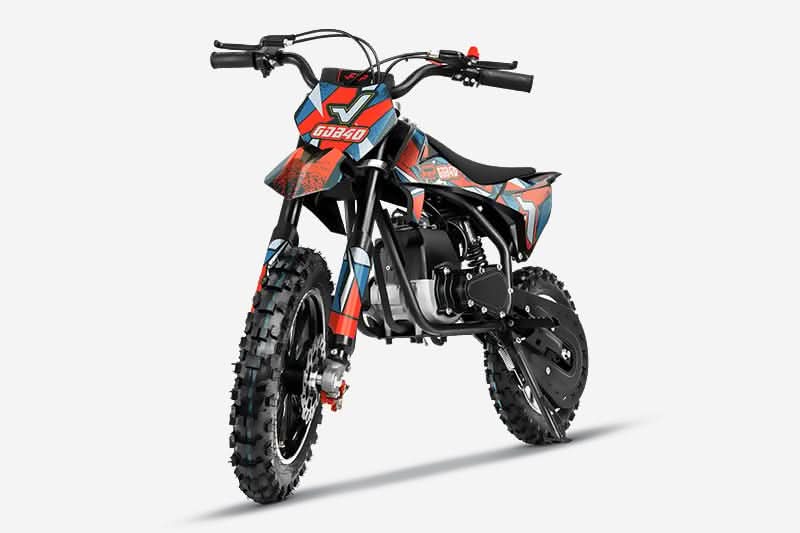 The tire and transmission configuration directly affect the grip performance. The mainstream models adopt tire specifications of 90/90-21 in the front and 140/80-18 in the rear, with tooth depths ranging from 8 to 15 millimeters. When the tire pressure drops to 12psi (the standard value is 15psi), the contact area with sand increases by 30%, but the risk of a blowout rises by 18% at the cost. Gear ratio optimization is equally crucial: for rock climbing terrain, the gear ratio of the first gear is often set at 3.0:1, combined with a large-diameter rear chainring (52 teeth), which limits the climbing Angle to 50 degrees, enhancing the passing ability by 10 degrees compared to standard gear ratio models. According to the GNCC race data, professional riders shift gears as frequently as 25 times per kilometer, and the wear rate of clutch plates is five times that of road motorcycles.
The coordinated optimization of the vehicle body structure and control design reduces energy consumption. The weight of the aluminum alloy double cradle frame is controlled within 25 kilograms, with a stiffness coefficient of 12,000 N·m/deg, and the deformation amplitude during continuous jumps is less than 0.3 millimeters. Ergonomic tests have confirmed that increasing the handlebar width to 820 millimeters and moving the footrests back by 20 millimeters can reduce the rider's muscle fatigue by 40% during a 30-minute rough ride. The 2024 Red Bull Erzberg Mine Challenge showed that all the finishing vehicles were equipped with anti-slip seats (with a friction coefficient of 0.8) and short-stroke throttle (with a rotation Angle of 65 degrees), which compressed the control accuracy error range from ±15° to ±7°.
The safety redundancy system has become a key focus of technological evolution. The latest model integrates an IMU inertial measurement unit (with a sampling rate of 100Hz). When it detects that the front wheels are off the ground by more than 40 degrees, the ECU will cut off the ignition and activate the rear wheel brake within 0.1 seconds. The off-road ABS system developed by Bosch has shortened the braking distance on gravel roads by 2.1 meters and reduced the accident rate by 17% compared with the previous year. According to the FIM Global Accident Report, the fuel leakage probability of vehicles equipped with elastic fuel tank brackets (with a deformation of 30 millimeters) in rolleover accidents has decreased from 12% to 0.5%, significantly improving the survival coefficient in complex terrains.
The tire and transmission configuration directly affect the grip performance. The mainstream models adopt tire specifications of 90/90-21 in the front and 140/80-18 in the rear, with tooth depths ranging from 8 to 15 millimeters. When the tire pressure drops to 12psi (the standard value is 15psi), the contact area with sand increases by 30%, but the risk of a blowout rises by 18% at the cost. Gear ratio optimization is equally crucial: for rock climbing terrain, the gear ratio of the first gear is often set at 3.0:1, combined with a large-diameter rear chainring (52 teeth), which limits the climbing Angle to 50 degrees, enhancing the passing ability by 10 degrees compared to standard gear ratio models. According to the GNCC race data, professional riders shift gears as frequently as 25 times per kilometer, and the wear rate of clutch plates is five times that of road motorcycles.
The coordinated optimization of the vehicle body structure and control design reduces energy consumption. The weight of the aluminum alloy double cradle frame is controlled within 25 kilograms, with a stiffness coefficient of 12,000 N·m/deg, and the deformation amplitude during continuous jumps is less than 0.3 millimeters. Ergonomic tests have confirmed that increasing the handlebar width to 820 millimeters and moving the footrests back by 20 millimeters can reduce the rider's muscle fatigue by 40% during a 30-minute rough ride. The 2024 Red Bull Erzberg Mine Challenge showed that all the finishing vehicles were equipped with anti-slip seats (with a friction coefficient of 0.8) and short-stroke throttle (with a rotation Angle of 65 degrees), which compressed the control accuracy error range from ±15° to ±7°.
The safety redundancy system has become a key focus of technological evolution. The latest model integrates an IMU inertial measurement unit (with a sampling rate of 100Hz). When it detects that the front wheels are off the ground by more than 40 degrees, the ECU will cut off the ignition and activate the rear wheel brake within 0.1 seconds. The off-road ABS system developed by Bosch has shortened the braking distance on gravel roads by 2.1 meters and reduced the accident rate by 17% compared with the previous year. According to the FIM Global Accident Report, the fuel leakage probability of vehicles equipped with elastic fuel tank brackets (with a deformation of 30 millimeters) in rolleover accidents has decreased from 12% to 0.5%, significantly improving the survival coefficient in complex terrains.
The tire and transmission configuration directly affect the grip performance. The mainstream models adopt tire specifications of 90/90-21 in the front and 140/80-18 in the rear, with tooth depths ranging from 8 to 15 millimeters. When the tire pressure drops to 12psi (the standard value is 15psi), the contact area with sand increases by 30%, but the risk of a blowout rises by 18% at the cost. Gear ratio optimization is equally crucial: for rock climbing terrain, the gear ratio of the first gear is often set at 3.0:1, combined with a large-diameter rear chainring (52 teeth), which limits the climbing Angle to 50 degrees, enhancing the passing ability by 10 degrees compared to standard gear ratio models. According to the GNCC race data, professional riders shift gears as frequently as 25 times per kilometer, and the wear rate of clutch plates is five times that of road motorcycles.
The coordinated optimization of the vehicle body structure and control design reduces energy consumption. The weight of the aluminum alloy double cradle frame is controlled within 25 kilograms, with a stiffness coefficient of 12,000 N·m/deg, and the deformation amplitude during continuous jumps is less than 0.3 millimeters. Ergonomic tests have confirmed that increasing the handlebar width to 820 millimeters and moving the footrests back by 20 millimeters can reduce the rider's muscle fatigue by 40% during a 30-minute rough ride. The 2024 Red Bull Erzberg Mine Challenge showed that all the finishing vehicles were equipped with anti-slip seats (with a friction coefficient of 0.8) and short-stroke throttle (with a rotation Angle of 65 degrees), which compressed the control accuracy error range from ±15° to ±7°.
The safety redundancy system has become a key focus of technological evolution. The latest model integrates an IMU inertial measurement unit (with a sampling rate of 100Hz). When it detects that the front wheels are off the ground by more than 40 degrees, the ECU will cut off the ignition and activate the rear wheel brake within 0.1 seconds. The off-road ABS system developed by Bosch has shortened the braking distance on gravel roads by 2.1 meters and reduced the accident rate by 17% compared with the previous year. According to the FIM Global Accident Report, the fuel leakage probability of vehicles equipped with elastic fuel tank brackets (with a deformation of 30 millimeters) in rolleover accidents has decreased from 12% to 0.5%, significantly improving the survival coefficient in complex terrains.
End of review
This Thursday: The Critic's Cut
One long-form review, one shorter polemic, and what we're reading against — delivered to 62,000 inboxes every Thursday morning. No ads, no denomination, no spin.
Read This Week's Review